It’s Advent and I want to talk about the End Times
Reading: Matthew 24:36-44
Happy New Year! It feels strange to say that when the calendar on the wall says December, but today marks the beginning of the Church’s liturgical year. We reset the clock. We change the colors to blue and violet. And we begin the season of Advent.
When we think of Advent, our minds naturally drift toward Christmas. We think of shepherds, angels, and a baby in a manger. We think of the first coming of Christ in history. But the Church, in her wisdom, does not start us there. On this First Sunday of Advent, the Gospel does not point us toward Bethlehem. It points us toward the end of time. It points us toward the Second Coming.
This focus on the end of the world brings back a vivid memory from my childhood.
When I was a little boy, my mother would take my brother and I with her to shop for groceries at the local Foodland or Safeway or browse the aisles at Sears or K-smart.
I remember standing in the checkout line, bored and shifting my weight from foot to foot. At that age, I was the perfect height to stare directly at the magazine racks.
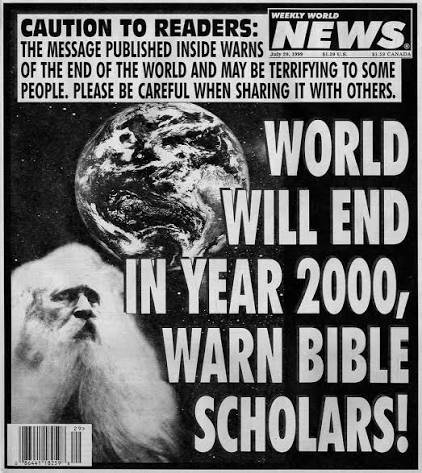
Specifically, I was eye level with the tabloids. I can clearly see those creepy Weekly World News covers screaming for attention. They announced things like "Bat Boy Discovered in Pendleton County, West Virginia" or the sensational headline, "I was Big Foot's Love Slave!"
But there was another common headline that appeared with alarming regularity: new proof that the world will end in the coming months or the coming year.
Now, I didn't know at that age that Weekly World News was an absurdist entertainment publication. Ironically, for someone who would later write for newspapers as an adult, I actually thought Weekly World News was a real hard news publication. I thought journalists had actually gone out, interviewed Bat Boy, and confirmed the apocalypse.
So I internalized those end of the world headlines. They terrified me. I often thought to myself, how am I supposed to prepare for this? What will the end look like? Will it be fire and chaos? Will I have time to run?
Those questions from my childhood in the grocery store checkout line are actually the same questions the disciples ask Jesus. And in today’s Gospel from Matthew, Jesus tells us what the end will look like. But his answer is very different from the tabloids.
The tabloids rely on sensationalism and specific dates. They tell you exactly when and exactly how, usually involving meteors or monsters. Jesus, however, says, "But about that day and hour no one knows, neither the angels of heaven, nor the Son, but only the Father."
Jesus tells us that the coming of the Son of Man will not look like a disaster movie. It will look like a normal Tuesday.
He compares it to the days of Noah. Now, we often think the people in Noah's time were struck down because they were doing visibly evil things. But look closely at what Jesus says. He says they were "eating and drinking, marrying and giving in marriage." These are not sins. These are the mundane activities of daily life.
Their sin was not that they were living, but that they were unaware. They were so absorbed in the routine of their lives, so distracted by the immediate, that they lost sight of God. They were spiritually asleep.
Jesus gives us an image of two men working in the field; one is taken, and one is left. Two women grinding meal together; one is taken, and one is left. This tells us that the end comes right in the middle of our work, our chores, our grocery shopping at Safeway. The difference between the one taken and the one left isn't their location or their job. The difference is the state of their hearts. One was ready. One was not.
This brings us back to the purpose of Advent.
We read and hear this Gospel today not only to await the coming of the Lord on Christmas, but also the coming of the Lord in the end times. We are living in the "in between" times.
The tabloids of my childhood tried to prepare me for the end through fear. They wanted me to panic. Jesus wants us to prepare through vigilance. He wants us to "stay awake." Or as the kids say, “Be woke!”
Staying awake or to be woke doesn't mean we stop living our lives. We still have to go to work, we still have to eat, and we still have to buy groceries. But we do it with a difference. We do it with one eye on the present moment and one eye on eternity.
To stay awake means to recognize that every moment is a gift from God, and every interaction is an opportunity to love. It means we don't put off our relationship with God until "later." We don't say, "I'll forgive that person next year," or "I'll start praying when I'm older."
The thief comes in the night, not to rob us, but to remind us that we do not own time. We are only stewards of it.
If I could go back and talk to that little boy standing in the checkout line at Times Supermarket or Daiei, terrified by the headlines, I would tell him not to worry. I would tell him that we do not need to fear the Bat Boys or the dates on the calendar.
We prepare for the end by living faithfully in the now. We prepare by inviting Christ into our mundane routines.
This looks like holding our family and friends in our hearts, actively cherishing them amidst our busy schedules.
It looks like forgiving our debts as we forgive our debtors, letting go of the small resentments that harden our hearts.
It means carving out time to listen to others in need, stopping our own motion long enough to truly hear them, and it means acting to provide what we can to them.
So as we light the first candle on the Advent wreath, let us embrace this holy season of waiting. Let us prepare a place for him in the manger of our hearts this Christmas, so that when he comes again in glory, he will find us awake, watchful, and ready to welcome him home.