Ask the Elder: Why does that painting look different from the other kinds?
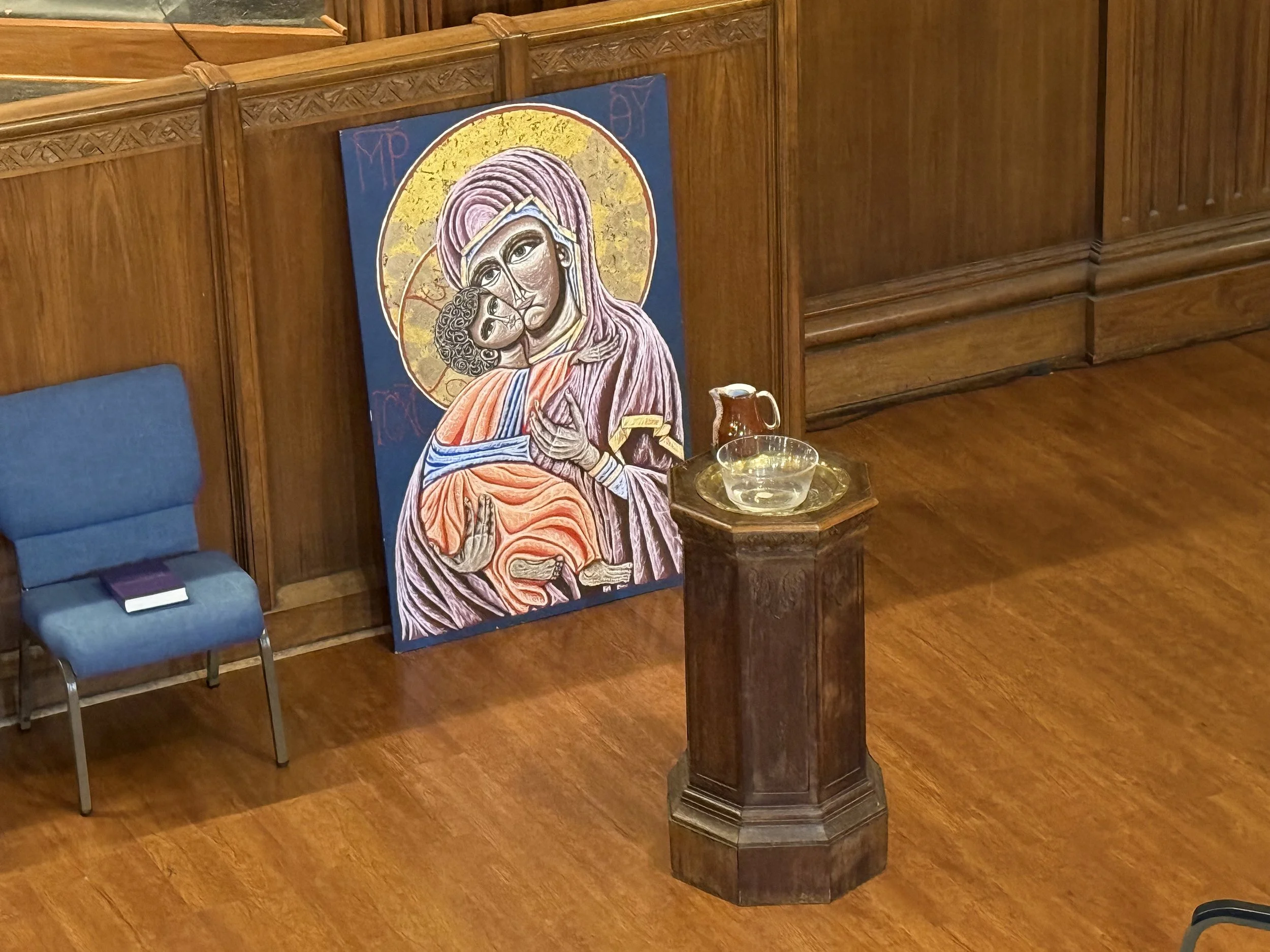
Sacred icon by the Rev. Nanette Sawyer, Fourth Presbyterian Church, Chicago, Ill. This icon is displayed in the Edgewater Kirk sanctuary. Photo: Gerald Farinas.
One of our wonderful neighbors from Bryn Mawr Cares, a supportive residential community across the street from our church, asked me as I prepared for worship:
“Why does that painting look different from the other kinds?”
Iconoclasm
First let’s go back in Presbyterian history.
There was a time when most Presbyterians were iconoclasts meaning they disapproved of religious imagery.
John Calvin, the foundational reformer for our denomination, believed that any physical representation of God, especially of Christ, was a violation of the Second Commandment.
In his Institutes of the Christian Religion, he argued that images in worship inevitably led to idolatry, since humans were prone to venerate the object rather than the divine reality it signified.
[John wasn’t very trusting of us, was he?]
This stance put him firmly in the Reformed tradition of iconoclasm, which was visible in the wave of image removals and destructions that swept through Geneva and other Reformed territories during his influence.
Back then, churches stripped altars, smashed statues, removed crucifixes, and whitewashed murals to eliminate anything seen as a distraction from God’s Word.
[Geez, Louise!]
However, John never really disapproved of their use outside of worship.
He permitted religious art for instructional or decorative purposes outside the context of worship.
And he had no objection to depictions of biblical stories in books or homes as long as they were not objects of devotion.
[John wasn’t a fun guy to be around when you really think about it.]
Art makes a comeback
In the late 1800s, Presbyterians began to introduce elements like stained glass windows.
[Uh oh. Gateway art.]
The General Assembly, our national ruling body, added language in the Book of Order that encouraged diverse expressions of worship. This opened the door to artistic elements grounded in Reformed theology appearing in churches.
In the early 2000s, congregations began to openly integrate representational religious art into worship spaces.
Some reflected the identity of the local churches—like African-style carvings and engravings, Asian-inspired liturgical cloths, quilts, even hula in Hawaii and indigenous chants in Native American congregations.
Peace Presbyterian Church in Lakewood Ranch, Florida explained, “The Book of Order underscores that worship spaces should foster reverence and community, drawing us into encounter with God, not serving as escapism. This broad principle doesn’t mandate art, but allows for creative environments that support worship.“
The PCUSA affirms through its educational materials that painting, sculpture, dance, music, and other artistic forms are gifts from God, pointing to biblical tradition in which God called artisans to create sacred art.
[Just letting you know: iconoclasts still exist in the PCUSA. They’re kinda quiet about it.]
The sacred icon
In the Orthodox Christian tradition, an icon is not just a picture.
It is theology in color, a visual Gospel.
The iconographer doesn’t “draw” or “paint” the icon. They “write” the icon.
The Rev. Nanette Sawyer wrote the icon we display in our sanctuary at the Edgewater Kirk.
It depicts Theotokos, the mother of God. Embracing her motherhood is the Christ child.
It sends many theological messages to the viewer:
The acceptance of the feminine in our church leadership;
Acknowledgement of traditions older than our denomination;
The embrace of Church as like a protective mother;
Recalling that our Savior was a person of color;
among others.
[What other messages do you read in this icon?]
The Rev. Sawyer wrote this icon through prayer, symbolism, and careful adherence to tradition, so that it proclaims the truth of God just as Scripture does in words.
Traditional icons are written using egg-based paints and gold leaf.
When you look at an icon, you are not simply seeing art. You are reading a holy text written with brush and pigment, meant to lead you into prayer and communion with God.